

RPPO considers a project and a programme as part of the same continuum of effective and sustainable delivery. Many projects fail due to the segmented nature of their implementation and management. After close-out, a project is frequently left isolated; with no ongoing monitoring or quality assurance. Our approach delivers the assurance to organisations and clients that their endeavours will have a lasting and meaningful impact.
Project and Programme Delivery & Management Continuum
PROJECT AND PROGRAMME
Delivery and Management Continuum
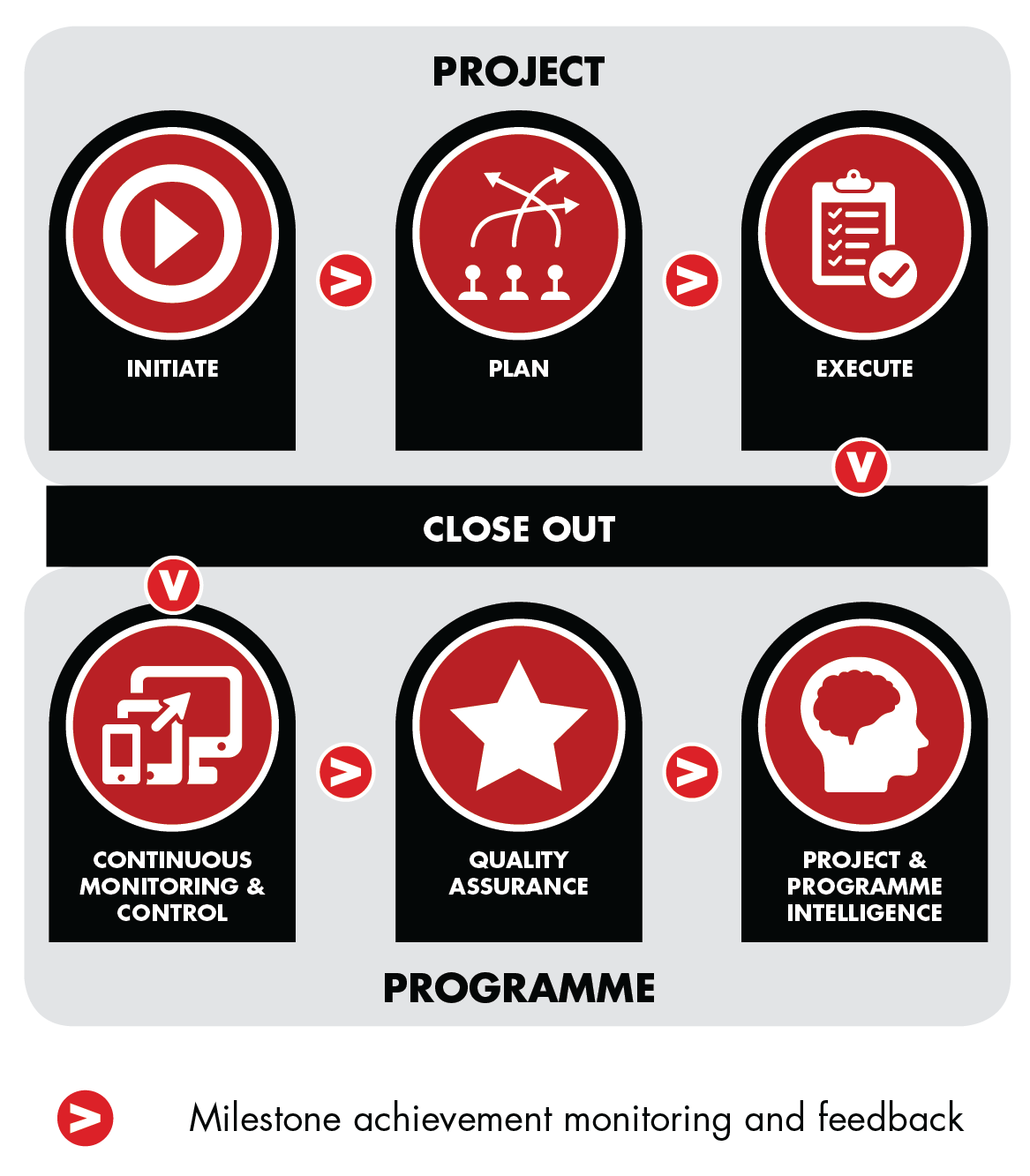
Project Management
-
Initiate
The initiation process authorises the overall project or the next phase of a project. In this phase, project objectives are established, scope is defined, and responsible parties and deliverables are identified.
-
Plan
Effective planning includes defining and the refinement of the best courses of action to take in order to attain the project objectives.
Planning falls into two categories: Core planning processes and facilitating processes.
- Core processes are those that have clear dependencies that require them to be performed in essentially the same order on most projects.
- Facilitating processes are entirely dependent on the nature of the project and are performed intermittently and as needed.
-
Execute
Execution involves coordinating all resources - human and otherwise - to carry out the overall project plan. Due to the on-going role execution plays in project management, its processes are also divided into core and facilitating subgroups. The central core process, project plan execution, oversees facilitating processes such as team development, information distribution, and solicitation.
-
Close Out
The project is accepted and brought to an orderly conclusion. The two main components of closing are contract close-out, in which any remaining open items are resolved and the contract is settled; and administrative closure, the collating of information to formalise project completion, including compiling lessons learned for use in future projects.
Programme Management
-
Monitor and control
While monitoring and control process are implemented throughout a project’s lifecycle, they are also vital to the on-going evaluation of the success of the project after implementation (programme management). Monitoring and control – or “watchdog” - processes ensure not only that project objectives are met, but also that corrective action can be taken should issues arise.
-
Ongoing quality assurance
Quality assurance (QA) is a critical element in programme management. With high levels of market competition, quality is often the market differentiator for almost all products and services. Once a project has been implemented, the value-add of QA assures the client or organisation that the offering is delivered in a sustainable manner for them.
-
Project and Programme Intelligence
So often after project implementation and close-out there is a void. Clients or organisations need the assurance that what has been delivered to them is effective, productive and sustainable. RPPO provides on-going intelligence and communication with regards to the efficacy of the project/programme and makes recommendations to ensure on-going true value.


